# Types of CCTV Camera: Dome, Bullet, PTZ, IP & Which to Buy in India
Author: Subhashree Das
Author URL: https://translineindia.com/blog/author/subhashree-das
Published: 2026-11-02
Category: AI for Smart Surveillance
Category URL: https://translineindia.com/blog/category/ai-for-smart-surveillance
Meta Title: Types of CCTV Camera: Dome, Bullet, PTZ and More (2026)
Meta Description: Types of CCTV camera: dome, bullet, turret, PTZ, fisheye, IP, analog, 4G and thermal explained, plus which to buy for homes, shops and sites in India.
Tags: AI CCTV Surveillance, Types of CCTV Camera, CCTV compliance
Tag URLs: AI CCTV Surveillance (https://translineindia.com/blog/tag/ai-cctv-surveillance), Types of CCTV Camera (https://translineindia.com/blog/tag/types-of-cctv-camera), CCTV compliance (https://translineindia.com/blog/tag/cctv-compliance)
URL: https://translineindia.com/blog/types-of-cctv-camera
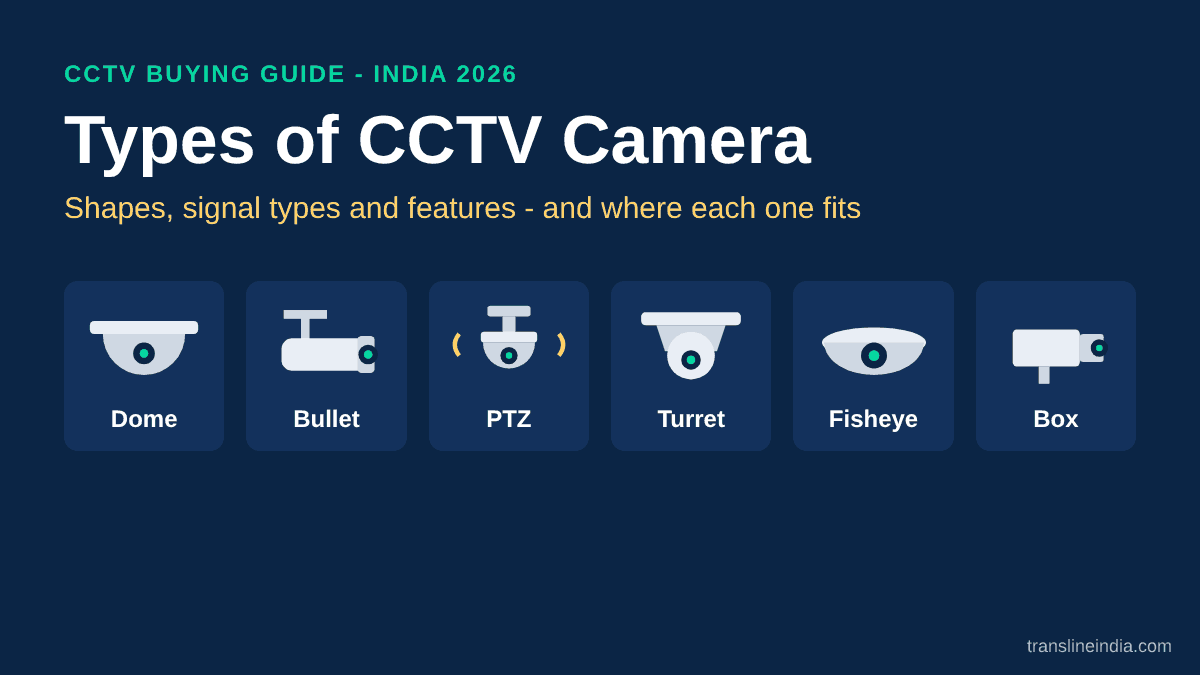
**Quick answer:** The main **types of CCTV camera** are dome, bullet, turret, PTZ, fisheye and box cameras, grouped by shape. Each shape also comes as an analog HD, IP, Wi-Fi or 4G camera, with features such as night vision, thermal imaging or ANPR. Pick the shape for the spot first, then the signal type, then the features.
## Key takeaways
- Think in three layers: shape, signal type and features.
- Dome and turret cameras suit indoor ceilings; bullet cameras suit outdoor walls and gates.
- PTZ and fisheye cameras cover large areas; ANPR and varifocal cameras capture plates and faces at entries.
- IP cameras with an NVR suit new sites; analog HD cameras with a DVR suit buildings that already have coax wiring.
- Since 1 April 2026, CCTV cameras sold in India must meet MeitY's Essential Requirements, tested under the STQC framework.
India is adding cameras fast. In October 2026, Delhi Chief Minister Rekha Gupta proposed 50,000 new CCTV cameras for the capital ( [ANI, 13 October 2026](https://aninews.in/news/national/general-news/delhi-plans-50000-new-cctv-cameras-smart-streetlights-with-automatic-fault-detection-cm-rekha-gupta20261013225223/)). Shops, offices, schools and housing societies are upgrading too. Yet most buyers still walk into a store and ask for "a CCTV camera", when there are many different types of CCTV cameras built for very different jobs. This guide explains each CCTV camera type in plain terms, compares the popular ones and shows which to buy for common Indian sites.
## What are the types of CCTV camera?
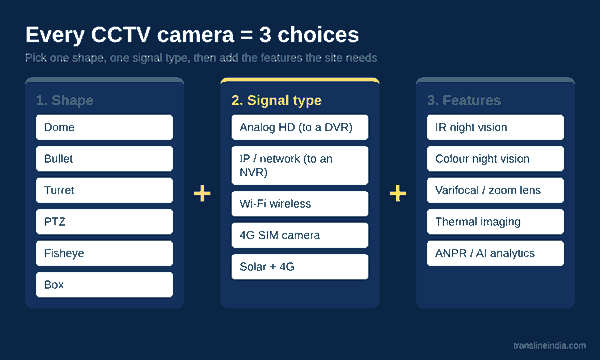
CCTV cameras are grouped three ways: by shape, by signal type and by special features. Most buying mistakes happen because these three get mixed up. A "dome IP camera with night vision" is one shape (dome), one signal type (IP) and one feature (infrared night vision).
- **Shape (form factor):** dome, bullet, turret, PTZ, fisheye and box. The shape decides where the camera mounts and what it can see.
- **Signal type:** analog HD, IP, Wi-Fi wireless and 4G. The signal type decides the wiring, the recorder and how far the system can grow.
- **Features:** night vision, zoom lenses, thermal imaging, number plate reading and AI analytics. Features decide what the camera can detect.
If you want a partner to plan all three layers for a whole site, see Transline's [CCTV surveillance solutions](https://translineindia.com/solutions/surveillance).
## Types of CCTV camera by shape
There are six common CCTV camera shapes: dome, bullet, turret, PTZ, fisheye and box. These are the CCTV camera types most people mean when they compare models in a shop.
### Dome camera
A dome camera sits inside a rounded cover fixed to the ceiling. Viewers cannot easily tell where it points, which makes it discreet and harder to dodge. Domes are the default for shops, offices, lobbies, corridors and classrooms. Vandal-resistant versions suit low ceilings and public areas. The trade-off: infrared light at night can reflect off a dirty or scratched dome cover and fog the image.
### Bullet camera
A bullet camera is a long tube on a wall bracket. It points in one clear direction and is easy to aim, so it works well on outdoor walls, gates, boundary lines and parking entrances. Because it is visible, it also acts as a deterrent. Bullets usually have a longer, narrower view than domes and more room for infrared LEDs. They are easier to knock out of position, so mount them high.
### Turret camera
A turret camera (sometimes called an eyeball camera) is a ball-shaped lens in a short mount, without a dome cover. It gives you dome-like placement without the night-time glare, and you can re-aim it after installation. Turrets suit both indoor and outdoor use and are a popular all-rounder for homes and small businesses.
### PTZ camera
A PTZ (pan, tilt, zoom) camera can rotate left and right, tilt up and down and zoom in on command. One PTZ can watch a large open area such as a road junction, yard, campus or parking lot, and follow a person or vehicle. PTZ cameras cost more and need an operator, preset tours or auto-tracking. They can only look one way at a time, so pair them with fixed cameras.
### Fisheye (360-degree) camera
A fisheye camera uses an ultra-wide lens to see a whole room, 180 or 360 degrees, from one ceiling point. It suits shop floors, halls, warehouses and open offices where you want the full picture with fewer cameras. Software "de-warps" the round image into normal views. Detail at the edges is lower, so do not rely on a fisheye to identify faces at a doorway.
### Box camera
A box camera is the classic rectangular body with a separate, interchangeable lens. It is used where a site needs a special lens or housing, such as long-range views in industrial plants. Box cameras are bulky and need an outdoor housing, so most homes and offices now choose a dome, bullet or turret instead.
### CCTV camera types at a glance
Type
Best for
Strength
Watch out for
Dome
Indoor ceilings, shops, lobbies
Discreet, hard to see where it points
IR glare off a dirty cover
Bullet
Outdoor walls, gates, perimeters
Visible deterrent, long narrow view
Can be knocked or tampered with
Turret
Indoor or outdoor all-rounder
No IR bounce, easy to re-aim
More visible than a dome
PTZ
Large open areas, roads, campuses
Pan, tilt and zoom to follow action
Looks one way at a time; needs presets or an operator
Fisheye
Shop floors, halls, warehouses
One camera covers a whole room
Less detail at the edges
Box
Special sites needing custom lenses
Swap lenses and housings
Bulky; needs a housing outdoors
## Dome vs bullet camera: which should you pick?
Choose a dome for indoor ceilings and discreet coverage, and a bullet for outdoor walls where a visible deterrent and a longer view help. Many sites use both: domes inside, bullets outside.
Point
Dome camera
Bullet camera
Look
Low-profile, discreet
Visible, acts as a deterrent
Mounting
Ceiling (some wall mounts)
Wall or pole bracket
Field of view
Wider, shorter range
Narrower, longer range
Tampering
Harder to re-aim or hit (vandal-resistant models)
Easier to knock or spray
Night vision
IR can glare off the cover
No cover glare, room for larger IR
Best spots
Shops, offices, classrooms, lobbies
Gates, boundary walls, parking, driveways
## Types of CCTV camera by signal type
By signal, a CCTV camera is analog HD (records to a DVR), IP (records to an NVR), Wi-Fi or 4G. Any of the shapes above can come in most of these signal types.
### Analog HD camera
Analog HD cameras send video over coaxial cable to a DVR (digital video recorder). Modern analog HD formats carry high-definition video, so they are a sensible upgrade for buildings that already have coax wiring. Each camera usually needs its own cable run and a separate power supply.
### IP camera
IP stands for Internet Protocol. An IP camera turns video into network data and sends it over a LAN cable to an NVR (network video recorder) or server. With PoE (Power over Ethernet), one cable carries both power and data. IP cameras generally offer higher resolution, easier expansion and better support for AI analytics, which is why most new commercial projects choose them. On large or multi-site systems, a [video management system such as CamPulse](https://translineindia.com/products/campulse) brings cameras from many locations into one place.
### Wi-Fi wireless camera
Wi-Fi cameras connect to a router without a data cable. They are quick to install in homes and small shops, but they still need power, and video quality depends on Wi-Fi strength. Walls and distance can cause dropped footage, so wired cameras remain the safer choice for critical spots.
### 4G SIM and solar camera
4G cameras take a SIM card and send video over the mobile network. Combined with a solar panel and battery, they work on construction sites, farms, highways and remote gates with no wired power or internet. Data plans and mobile signal strength are the main limits.
### IP camera vs analog camera
Point
IP camera
Analog HD camera
Recorder
NVR or server
DVR
Cable
LAN (PoE carries power too)
Coax plus separate power
Image quality
Usually higher resolution options
HD, fewer high-resolution options
AI analytics
Easier to add
Limited, often needs extra hardware
Best for
New buildings, multi-site, smart features
Upgrading old coax systems on a budget
Higher-resolution IP cameras also need more storage. Before you buy disks, use our [CCTV storage calculator](https://translineindia.com/blog/cctv-storage-calculator) to size storage from bitrate, camera count and retention days. If you already have the cameras and need longer retention, [CamStore compresses CCTV footage by up to 80%](https://translineindia.com/products/camstore).
## Types of CCTV camera by special features
Features are added on top of the shape: night vision, zoom, thermal imaging, number plate reading and AI analytics.
- **IR night vision:** infrared LEDs light the scene in the dark and give a black-and-white image. Standard on most cameras.
- **Colour night vision:** sensitive sensors or a soft white light keep colour at night, which helps identify clothes and vehicles.
- **Varifocal or motorised zoom lens:** lets the installer adjust the field of view after mounting, which is useful at gates and counters where you need faces.
- **Thermal camera:** detects heat instead of light, so it sees people and vehicles in total darkness, smoke or fog. Used for perimeters, plants and borders.
- **ANPR camera:** reads vehicle number plates at entries, toll points and roads. See our [ANPR camera guide](https://translineindia.com/blog/anpr-camera) and how it fits a [smart parking system](https://translineindia.com/blog/smart-parking-system-india).
- **Face recognition and AI analytics:** software that detects people, intrusion, loitering, crowds or faces. Read more in our [AI CCTV camera guide](https://translineindia.com/blog/ai-cctv-camera-india-features-cost).
You do not always need new AI cameras. [StorePulse AI video analytics](https://translineindia.com/products/storepulse) works with existing CCTV, so many sites add people counting, ANPR or intrusion alerts to the cameras they already have.
## Which CCTV camera type fits which site in India
Most Indian sites need a mix: domes inside, bullets or turrets outside, and PTZ or ANPR where people and vehicles move.
Site
Indoor
Outdoor
Extras to consider
Home or flat
Turret or dome
Bullet at gate
Wi-Fi or 4G if no wired network
Shop or showroom
Dome, fisheye on the floor
Bullet at entrance
Footfall counting, cash counter close-up
Office
Dome in corridors, turret at reception
Bullet on parking
Varifocal at entry for faces, visitor management
School or college
Dome in corridors and labs
Bullet or turret on gates and grounds
PTZ for large campuses
Bank branch or ATM
Vandal-resistant dome
Bullet at entrance
Camera health alerts, long retention
Warehouse or factory
Fisheye or dome
Bullet on perimeter, PTZ in yards
Thermal for dark perimeters
City road or junction
Not usually needed
Bullet and PTZ
ANPR and face recognition
City projects show the mix at scale. For Delhi's Safe City project, officials said the first 3,500 AI-enabled cameras would be drawn from a larger pool of 6,121 bullet, 1,622 ANPR, 370 face recognition and 1,876 PTZ cameras ( [ThePrint, PTI, 12 July 2025](https://theprint.in/india/3500-ai-enabled-cameras-to-guard-delhi-under-safe-city-project-from-oct-1/2688353)). For sector-specific planning, see Transline's pages for [retail](https://translineindia.com/industries/retail), [education](https://translineindia.com/industries/education), [banking and finance](https://translineindia.com/industries/banking-finance), [government](https://translineindia.com/industries/government) and [industrial infrastructure](https://translineindia.com/industries/industrial-infrastructure). Retailers can also read about using a [footfall counter with existing cameras](https://translineindia.com/blog/footfall-counter-retail-stores), offices can pair entry cameras with a [visitor management system](https://translineindia.com/blog/visitor-management-system), and city planners can see our [smart city surveillance system guide](https://translineindia.com/blog/smart-city-surveillance-system-guide-2026).
## How to choose the right CCTV camera type: 6 steps
Walk the site plan spot by spot and answer six questions.
1. **Indoor or outdoor?** Indoor: dome, turret or fisheye. Outdoor: bullet or turret with a weatherproof rating.
2. **Wide open area?** Use a fisheye for one room or a PTZ for roads, yards and campuses.
3. **Faces or number plates?** Add a varifocal lens or an ANPR camera at a narrow entry point.
4. **Dark or harsh site?** Pick IR or colour night vision; use thermal for perimeters in fog or total darkness.
5. **Existing coax wiring?** Keep analog HD with a DVR, or move to IP cameras and an NVR for new sites.
6. **Compliant model?** Check the model's STQC test report and BIS registration before you buy (see the rules section below).
## What affects the cost of each CCTV camera type
Price depends on shape, resolution, lens, night vision, signal type and certification more than on brand. Typical cost drivers are:
- **Shape:** PTZ and thermal cameras cost far more than fixed domes, bullets and turrets.
- **Resolution and sensor:** higher megapixels and better low-light sensors raise the price and the storage needed.
- **Lens:** varifocal and motorised zoom lenses cost more than fixed lenses.
- **Night vision:** longer IR range and colour night vision add cost.
- **Signal type:** IP cameras need PoE switches and an NVR; 4G cameras need SIMs and data plans; analog HD can reuse old coax.
- **Housing:** weatherproof and vandal-resistant housings for outdoor and public areas.
- **Certification and support:** compliant, certified models, warranty and on-site service.
Get a site survey and a line-item quote rather than comparing single camera prices; cabling, recorders, storage and installation often cost as much as the cameras.
## India rules to check before you buy
Since 1 April 2026, connected CCTV cameras sold in India must meet certification standards under the STQC framework ( [The News Minute, 1 April 2026](https://www.thenewsminute.com/news/explained-why-india-is-restricting-chinese-cctv-cameras-from-april-1)). The rule comes from the Essential Requirements issued by MeitY in April 2024, which call for testing against vulnerabilities that could allow unauthorised remote access and disclosure of the country of origin of key components such as chipsets. Large buyers are already acting: Delhi decided to replace about 1.4 lakh road cameras installed between 2020 and 2022, starting with 50,000 in the first phase ( [India.com, 2 April 2026](https://www.india.com/news/india/rekha-gupta-arvind-kejriwal-delhi-government-chinese-cctv-public-works-department-pwd-parvesh-verma-manish-sisodia-kapil-mishra-8365211/)). Before you buy any camera, check the exact model and firmware. Our guide to the [STQC certified CCTV camera](https://translineindia.com/blog/stqc-certified-cctv-camera) rules shows how to verify one.
## How Transline helps
Transline designs and integrates surveillance for enterprises, campuses and government sites across India. Our team can survey a site, choose the right mix of camera types and plan cabling, recording and storage as part of our [surveillance](https://translineindia.com/solutions/surveillance) and [ELV systems](https://translineindia.com/solutions/elv) work. [CamPulse](https://translineindia.com/products/campulse) is our video management system for managing cameras across locations in one place, [StorePulse](https://translineindia.com/products/storepulse) adds AI video analytics to existing cameras, [CheckCam camera health monitoring](https://translineindia.com/products/checkcam) flags offline cameras and recording gaps, and [CamStore](https://translineindia.com/products/camstore) compresses CCTV footage by up to 80%. Planning a new system or an upgrade? [Talk to our team](https://translineindia.com/contact).
## FAQs
Q: What are the main types of CCTV camera?
A: By shape, the main types of CCTV camera are dome, bullet, turret, PTZ, fisheye and box. By signal type, they are analog HD, IP, Wi-Fi and 4G. Features such as night vision, thermal imaging, ANPR and AI analytics sit on top, so one camera combines a shape, a signal type and features.
Q: What type of CCTV is best?
A: No single type is best for every spot. For most new sites, IP cameras work best, with domes or turrets indoors and bullets or turrets outdoors. Add PTZ cameras for large open areas and ANPR or varifocal cameras at entry points where you need number plates or faces. See our CCTV surveillance solutions for site-specific planning.
Q: Which CCTV camera is better, HD or IP?
A: IP cameras are usually better for new installations because they offer higher resolution, single-cable PoE and easier AI analytics. Analog HD cameras make sense when you want to reuse existing coax wiring at a lower upfront cost. Many sites run both during a phased upgrade from analog to IP, managed in one video management system.
Q: Which CCTV camera is best, DVR or NVR?
A: DVR and NVR are recorders, not cameras. A DVR records analog HD cameras over coax cable; an NVR records IP cameras over a network. Choose the recorder that matches your cameras. For new sites, IP cameras with an NVR are the common choice because they scale more easily and support analytics. Use our CCTV storage calculator to size the recorder.
Q: What are the four types of cameras?
A: The four types of CCTV camera most often listed are dome, bullet, PTZ and turret. Fisheye and box cameras are two more shapes, used for wide rooms and special lenses. Each of these shapes can come as an analog HD, IP, Wi-Fi or 4G camera.
Q: Which CCTV camera is best for a home in India?
A: A turret or dome camera indoors and a bullet or turret camera at the gate cover most homes. If you have no wired network, Wi-Fi or 4G cameras work well. Before buying, check that the exact model is compliant with India's CCTV certification rules and has its BIS registration.
Q: What is the full form of IP camera?
A: IP camera stands for Internet Protocol camera. It turns video into network data and sends it over a LAN cable or Wi-Fi to an NVR, server or cloud. With PoE, one LAN cable carries both power and video, which makes IP cameras easier to install and expand.
---
This blog is powered by Superblog. Visit https://superblog.ai to know more.
---