# Door Access Control System: Types, Biometric vs RFID and Cost
Author: Subhashree Das
Author URL: https://translineindia.com/blog/author/subhashree-das
Published: 2026-11-18
Category: ELV and Building Systems
Category URL: https://translineindia.com/blog/category/elv-and-building-systems
Meta Title: Door Access Control System: Types, Biometric vs RFID, Cost
Meta Description: Door access control system guide for India: types, how it works, biometric vs RFID, fail-safe locks, DPDP rules and the factors that decide cost.
Tags: biometric attendance, Door Access Control System, RFID Access Control, Access Control
Tag URLs: biometric attendance (https://translineindia.com/blog/tag/biometric-attendance), Door Access Control System (https://translineindia.com/blog/tag/door-access-control-system), RFID Access Control (https://translineindia.com/blog/tag/rfid-access-control), Access Control (https://translineindia.com/blog/tag/access-control)
URL: https://translineindia.com/blog/door-access-control-system
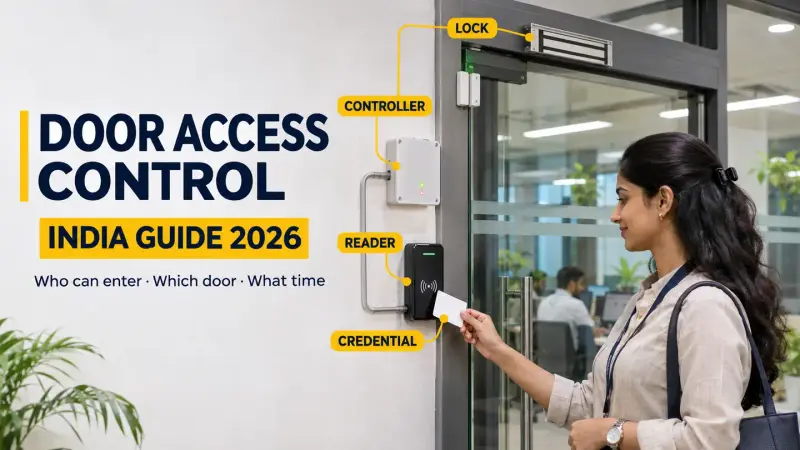A door access control system links a credential, reader, controller and lock.
**Quick answer:** A **door access control system** decides who can open which door and when, using a credential such as a PIN, RFID card, fingerprint, face or phone. A reader sends the ID to a controller, the controller checks its rules, releases the lock if allowed and logs every attempt.
## Key takeaways
- Every system has five core parts: credential, reader, controller, lock and software.
- Biometric credentials (face or fingerprint) stop card sharing; RFID cards are faster and cheaper per door. Many sites use both.
- Exit doors must open on a fire alarm or power cut, so choose fail-safe locks and add a manual release.
- Face and fingerprint templates are personal data under India's DPDP Act: collect them with notice, keep them secure and delete them when people leave.
- Cost depends on doors, credential type, lock hardware, cabling and power, software and maintenance, not just the reader.
Keys get copied, lost and lent. A door access control system replaces them with rules you can change in seconds and a record of every entry. Interest is rising across India in 2026: in October, the Bureau of Civil Aviation Security described a new airport entry permit system with facial biometric verification on a common platform across all 169 airports, where entry permits are "touching 15 lakh every year" ( [Aviation Today, 3 October 2026](https://www.aviationtoday.in/civilaviation/airports/india-plans-digital-airport-entry-permits-and-facial-biometrics-at-169-airports/)). This guide explains how the technology works, the types you can choose, and how to plan one for an office, hospital, bank, factory or campus. For a ready design, see our [biometric and access control solutions](https://translineindia.com/solutions/biometrics).
## What is a door access control system?
A door access control system is an electronic way to control who can enter a building, floor or room, where they can go and at what times. It is physical access control (the doors, gates, turnstiles and lifts of a site) rather than IT access control, which governs logins to software and networks.
Physical access control means "restricting entrance to a property, a building, or a room to authorized persons" ( [Wikipedia, Access control](https://en.wikipedia.org/wiki/Access_control)). People prove who they are with one or more factors:
- **Something you know:** a PIN or password.
- **Something you have:** an RFID card, key fob or phone.
- **Something you are:** a fingerprint or face.
Using two factors together, such as card plus PIN or card plus face, makes it much harder for someone to borrow another person's access.
### Key access control terms
- **Credential:** what a person presents to prove identity, such as a card, PIN, fingerprint or face.
- **Controller (panel):** the device that checks the credential against its rules and drives the lock.
- **Fail-safe lock:** a lock that releases when power is cut, used on escape routes.
- **Fail-secure lock:** a lock that stays locked when power is cut, used on stores and strong rooms.
- **Anti-passback:** a rule that stops a card being used to enter twice without exiting.
- **Tailgating:** when someone follows an authorised person through a door without using their own credential.
## How does a door access control system work?
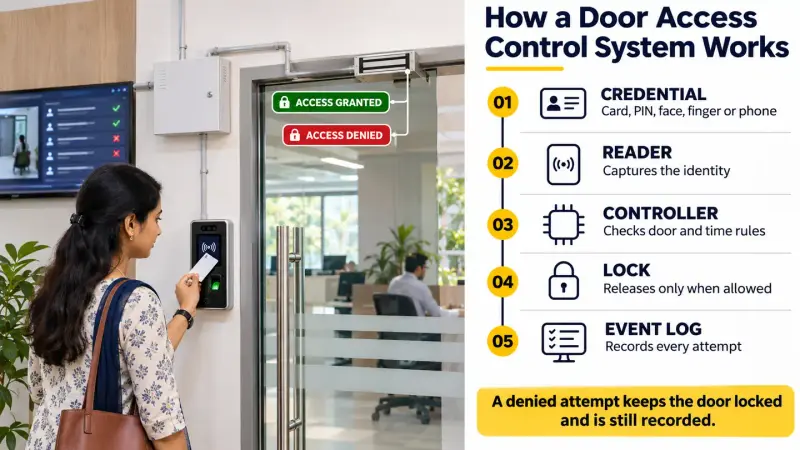Five steps connect the credential to the event log, while a denied attempt keeps the door locked.
A door access control system works in five steps:
1. **Credential:** the user shows a card, enters a PIN, places a finger or looks at a face reader.
2. **Reader:** the reader at the door captures the ID and sends it to the controller.
3. **Controller:** the access control panel compares the ID with its access list: is this person allowed through this door at this time?
4. **Lock:** if the answer is yes, the controller switches a relay and the lock releases for a few seconds.
5. **Log:** the event is saved in the access control software, whether it was allowed or denied.
This matches the standard flow for physical access control, where the control panel compares the credential's number to an access control list, grants or denies the request and sends a transaction log to a database ( [Wikipedia](https://en.wikipedia.org/wiki/Access_control)).
### What happens when access is denied?
The lock stays shut, the reader usually shows a red light or beep, and the attempt is logged. Good software can alert security after repeated failures, a forced door or a door left open too long.
## Key components of an access control system
An access control system is a chain of parts. If one is weak (a lock without backup power, a reader with no tamper alarm), the whole door is weak.
Component
What it does
Common options
Credential
Proves identity
PIN, RFID card or fob, fingerprint, face, mobile
Reader
Captures the credential at the door
Keypad, card reader, biometric terminal
Controller (panel)
Applies rules and drives the lock
Single-door standalone, multi-door networked, cloud-managed
Lock
Holds the door shut
Electromagnetic lock, electric strike, drop bolt
Door sensor and exit button
Detects door open and lets people out
Magnetic door contact, push-to-exit, break-glass release
Power supply
Keeps the system running
Power supply with battery backup
Access control software
Manages users, schedules, reports
On-premise, web or cloud
Readers often talk to controllers over Wiegand, a wiring standard that grew out of card readers popular in the 1980s and whose original format is 26 bits ( [Wikipedia, Wiegand interface](https://en.wikipedia.org/wiki/Wiegand_interface)). Controllers then connect to a server over RS-485 or a TCP/IP network. Planning this cabling and power is part of a wider [ELV system](https://translineindia.com/blog/elv-system) design.
## Types of access control systems
You can group access control systems three ways: by credential, by architecture and by access model.
### By credential
- **PIN keypad:** cheapest and simplest, but PINs are easy to share or watch being typed.
- **RFID access control system:** users tap a card or fob. Fast and familiar; the risk is lost or lent cards.
- **Biometric access control system:** fingerprint or face. Ties entry to the person, so it cannot be lent. Read more on [biometric authentication](https://translineindia.com/blog/hrms-attendance-management/biometric-authentication).
- **Face recognition door lock or terminal:** touchless and quick at busy entrances. See how [facial recognition](https://translineindia.com/blog/hrms-attendance-management/facial-recognition) works.
- **Mobile credential:** a phone app with Bluetooth or NFC, popular in co-working and multi-tenant buildings.
### By architecture
- **Standalone:** reader, controller and memory in one unit on one door. Good for a server room or a single office.
- **Networked (wired):** many doors report to central software. Best for multi-floor offices, hospitals and plants.
- **Cloud-managed:** controllers sync to a hosted platform, so admins can manage sites from a browser. Needs a plan for internet outages.
### By access model
When people ask about the "three types of access control", they usually mean these models:
- **Discretionary (DAC):** the owner of a space decides who gets in.
- **Mandatory (MAC):** a central authority sets fixed clearance levels, common in defence and labs.
- **Role-based (RBAC):** access follows the job role, such as "finance team" or "housekeeping". Most Indian offices use this.
## Biometric vs RFID access control: which is better?
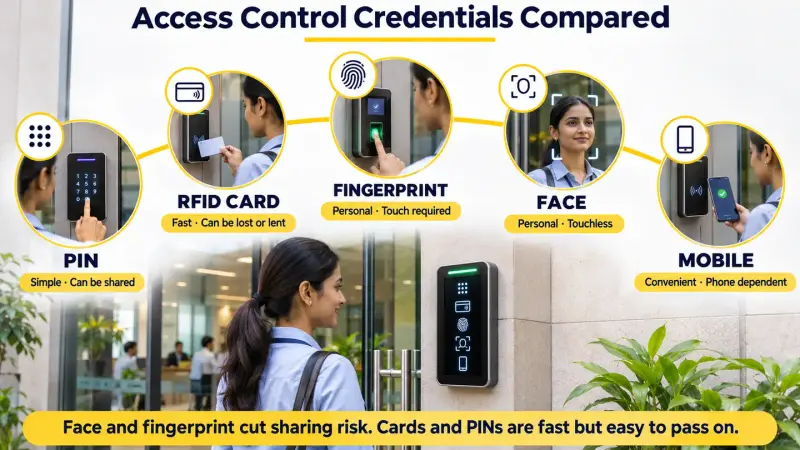Comparison of PIN, RFID card, fingerprint, face and mobile credentials for a door access control system
Biometric access control is better when you must be sure who walked in; RFID is better when you need speed and low cost per user. For critical rooms, combine them.
Factor
RFID card or fob
Biometric (face or fingerprint)
Can it be shared or lent?
Yes
No
Speed at a busy door
Very fast
Fast (face), medium (fingerprint)
Running cost
Card issue and replacement
Little after enrolment
Touchless
Yes
Face yes, fingerprint no
Privacy duties
Low
Higher: templates are personal data
Best for
General staff doors, parking, lifts
Server rooms, cash rooms, labs, pharmacy stores
Many devices sold in India combine attendance and access in one terminal. If you are comparing devices, our guide to [biometric machine prices](https://translineindia.com/blog/biometric-attendance-machine-price-india) explains what changes the price.
## Where door access control systems are used in India
Any building with rooms that only some people should enter can use a door access control system. Common Indian use cases:
### Offices and IT parks
A door access control system for office use typically covers the main entrance, floor doors, server rooms and record rooms, with time rules for housekeeping and vendors. Shared buildings add lift and turnstile control, and front desks pair it with a [visitor management system](https://translineindia.com/blog/visitor-management-system).
### Hospitals
ICUs, operation theatres, pharmacy stores and newborn units need tight control. In 2024, AIIMS Delhi started a pilot of a facial recognition-based access control system with a visitor management system in its Mother and Child Block ( [Medical Dialogues, 20 October 2024](https://medicaldialogues.in/news/health/hospital-diagnostics/delhi-aiims-launches-facial-recognition-access-control-system-to-enhance-patient-safety-136697)). More on [hospitals](https://translineindia.com/industries/healthcare).
### Banks and finance
Strong rooms, cash rooms and data rooms often use two-factor entry and interlocked doors. See [banking and finance](https://translineindia.com/industries/banking-finance).
### Factories and warehouses
Restricted plant areas, stores and hazardous zones benefit from role-based access and muster reports during evacuations. See [industrial sites](https://translineindia.com/industries/industrial-infrastructure).
### Campuses
Hostels, labs and exam rooms can use time-bound access for students and staff. See [education](https://translineindia.com/industries/education).
### Government buildings and airports
In late October 2026, the Madhya Pradesh Secretariat was preparing face recognition attendance, with employees scanning their faces when entering and leaving, while manual visitor passes were set to be replaced with computerised passes ( [Dainik Jagran MP-CG, 30 October 2026](https://english.dainikjagranmpcg.com/states/madhya-pradesh/madhya-pradesh-secretariat-to-introduce-face-recognition-attendance-from-november/article-41865)). At airports, the government plans to require facial recognition screening for airport and airline staff ( [ID Tech Wire, 2 October 2026](https://idtechwire.com/india-plans-mandatory-facial-recognition-for-airport-and-airline-staff/)). See [government](https://translineindia.com/industries/government) and [transportation](https://translineindia.com/industries/transportation).
## Fire safety and power: fail-safe vs fail-secure locks
Every access-controlled door on an escape route must open in an emergency, even if the power fails. That decides which lock you use.
- **Fail-safe:** unlocks when power is cut. Direct-pull electromagnetic locks are "inherently fail-safe", and typical single-door units are offered with 600 or 1,200 lbf holding force ( [Wikipedia, Electromagnetic lock](https://en.wikipedia.org/wiki/Electromagnetic_lock)). Use these on exits.
- **Fail-secure:** stays locked when power is cut. Suits stores, cash rooms and server rooms that are not escape routes, as long as there is a manual key override.
Good practice for exits: wire the controller to the fire alarm so doors release automatically, add a green break-glass or emergency release button, and give the controller a battery backup so logs and rules survive a power cut. India's National Building Construction Standards (NBCS) 2026 are now voluntary guidelines, so check your state fire service and fire NOC conditions with your consultant before finalising locks.
## Access control, biometric data and the DPDP Act
Face and fingerprint templates identify a person, so they are personal data under India's Digital Personal Data Protection framework. If your door access control system uses biometrics, plan for:
- A clear notice explaining why biometrics are collected and how long they are kept.
- Use only for access (and attendance, if stated), not for unrelated purposes.
- Encrypted storage, role-based admin access and audit logs.
- Deleting templates when an employee, student or contractor leaves.
- A card or PIN alternative for people who cannot enrol.
Timelines matter: Rule 4 of the DPDP Rules on consent managers came into force on 13 November 2026, and the main operational provisions are scheduled to start on 13 May 2027 ( [S.S. Rana & Co., 10 November 2026](https://ssrana.in/articles/dpdp-act-compliance-what-organizations-must-do-before-the-november-2026-consent-manager-deadline/)). Visitor data raises the same questions; see our [visitor management system guide](https://translineindia.com/blog/visitor-management-system). This is general information, not legal advice.
## Integrations: attendance, visitors, CCTV, lifts and gates
Access data is far more useful when it is connected to the rest of your building systems:
- **Attendance and payroll:** one face or fingerprint terminal can serve both entry and attendance. Read our [attendance management system](https://translineindia.com/blog/attendance-management-system) guide, or see [IDOne](https://translineindia.com/products/idone), Transline's HRMS and biometric attendance platform.
- **Visitors:** issue time-limited passes or QR codes that expire automatically.
- **CCTV:** place cameras at controlled doors so a forced door or denied entry can be checked on video. [CamPulse](https://translineindia.com/products/campulse) brings cameras across sites into one video management system, and [video analytics](https://translineindia.com/blog/video-analytics) can add intrusion and crowding alerts.
- **Lifts, turnstiles and boom barriers:** restrict floors per user and control vehicle entry, as in a [smart parking system](https://translineindia.com/blog/smart-parking-system-india).
- **Anti-passback:** blocks a card from being used to enter twice without exiting, which stops people passing cards back through the door.
## Access control system cost in India: what drives the price?
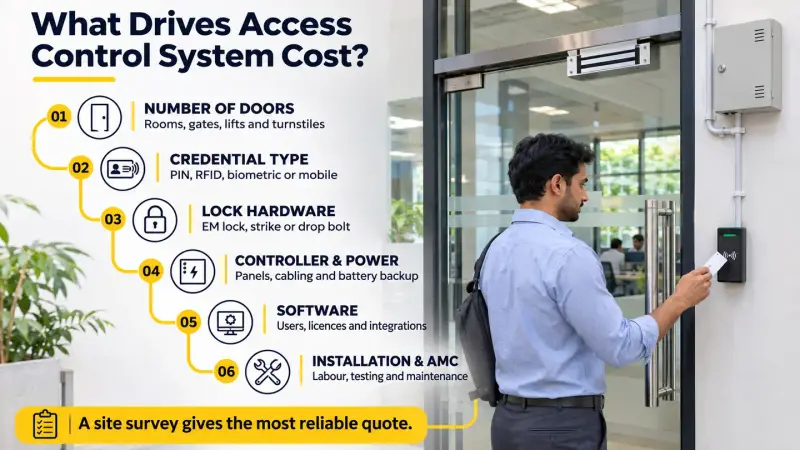Door count, credential type, lock hardware, controllers, software and installation determine the final system cost.
An access control system is usually priced per door plus software, so the number of doors and how secure each one must be drive most of the cost. Six factors decide the final quote:
1. **Number of doors:** include gates, turnstiles and lifts, not just room doors.
2. **Credential type:** PIN and RFID readers cost less than face or fingerprint terminals; cards add a running cost.
3. **Lock hardware:** EM lock, electric strike or drop bolt, plus door closers and brackets for glass doors.
4. **Controller, cabling and power:** networked panels, cable runs and battery-backed power supplies.
5. **Software and licences:** number of users and doors, cloud subscription, integrations with HR and CCTV.
6. **Installation and AMC:** labour, testing, training and annual maintenance.
Because door types and cable routes vary so much, the most reliable number comes from a site survey. [Talk to our team](https://translineindia.com/contact) for a survey-based quote.
## How to plan a door access control system installation in 7 steps
1. **List doors and zones:** mark every entry, exit, lift and restricted room on a floor plan.
2. **Define user groups and time rules:** staff, managers, housekeeping, vendors, visitors: who goes where, and when.
3. **Choose credentials per zone:** card for general doors, biometric or two-factor for high-risk rooms.
4. **Choose the lock for each door:** fail-safe on escape routes, fail-secure where allowed; check door frames and glass.
5. **Plan cabling, network and backup power:** controller locations, cable routes, UPS or battery backup. Coordinate with your [IT infrastructure](https://translineindia.com/solutions/it-infrastructure) team.
6. **Decide integrations:** fire alarm, attendance, visitor management, CCTV, lifts.
7. **Test, train and maintain:** test every door including fire release, train admins, and set an AMC and a process to remove leavers the same day.
## Common mistakes to avoid
- Fitting fail-secure locks on fire exits.
- No battery backup for controllers and locks.
- Ignoring tailgating. Simply following a legitimate user through a door is the most common way to get past an access control system ( [Wikipedia](https://en.wikipedia.org/wiki/Access_control)), so use turnstiles, door-held-open alarms or CCTV.
- Shared PINs and generic "admin" cards.
- No process to deactivate cards and delete biometrics when people leave.
- Old unencrypted proximity cards and readers that never get firmware updates.
## How Transline helps
Transline Technologies designs, supplies, installs and integrates door access control as part of complete building security. Our [biometric and access control solutions](https://translineindia.com/solutions/biometrics) cover card and biometric entry, and connect with [ELV systems](https://translineindia.com/solutions/elv) such as fire alarms and cabling, [surveillance](https://translineindia.com/solutions/surveillance) managed through [CamPulse](https://translineindia.com/products/campulse), and HRMS and attendance through [IDOne](https://translineindia.com/products/idone). We help you map doors and zones, pick the right credential and lock for each door, and plan for fire safety and DPDP from day one.
Planning access control for an office, hospital, campus or plant? [Book a site survey with Transline](https://translineindia.com/contact).
## FAQs
Q: What is the main function of access control?
A: Access control lets the right people through the right doors at the right times, and keeps a record of every attempt. It replaces keys with rules you can change instantly, so a lost card or a leaver can be blocked in seconds instead of changing locks. See our access control and biometrics solutions.
Q: What are the three types of access control?
A: The three classic models are discretionary, mandatory and role-based access control. Most offices use role-based access, where permissions follow a person's job or department. Mandatory access suits defence and labs, while discretionary access lets each space owner decide who gets in.
Q: What are the 5 parts of a door access control system?
A: The five core parts are the credential, reader, controller, lock and software. Most doors also need a door sensor, an exit button and a power supply with battery backup, so the door stays secure and still opens safely during a power cut. Access control is one part of a wider ELV system.
Q: Is biometric access control better than RFID?
A: Biometric access control is more secure because a face or fingerprint cannot be lent, while RFID cards are faster and cheaper per user. Many sites use RFID for general doors and biometrics or card plus PIN for critical rooms such as server rooms and cash rooms. Read more on biometric authentication.
Q: What happens to an access-controlled door during a power cut or fire?
A: Fail-safe locks such as electromagnetic locks release when power is cut, and doors on escape routes should also release on a fire alarm signal. Controllers need battery backup so rules and logs survive outages, and exits need a manual emergency release button.
Q: Can a door access control system work with attendance software?
A: Yes. A face or fingerprint terminal can record entry and attendance together, so employees do not need a separate punch. Before you buy, check that your access software and HRMS can exchange data, and that the same notice covers both uses of biometric data. Learn how IDone links access and attendance.
Q: Is face or fingerprint data allowed under India's DPDP Act?
A: Biometric data can be used with a clear notice, a stated purpose, proper security and deletion when no longer needed. Offer a card alternative where possible, keep access logs, and take legal advice for your specific case, as the main DPDP duties start on 13 May 2027. See our guide to facial recognition.
Q: How much does a door access control system cost in India?
A: Cost depends on the number of doors, credential type, lock hardware, cabling and power, software licences, and installation and AMC. Biometric terminals and glass-door locks cost more than PIN or card readers. A site survey gives the most accurate, door-by-door quote. Talk to an Expert through our contact page for a site-specific quote.
---
This blog is powered by Superblog. Visit https://superblog.ai to know more.
---