# Attendance Management System in India: Types, Features, Labour Code Rules and Cost (2026)
Author: Subhashree Das
Author URL: https://translineindia.com/blog/author/subhashree-das
Published: 2026-10-18
Category: HRMS and Attendance Management
Category URL: https://translineindia.com/blog/category/hrms-and-attendance-management
Meta Title: Attendance Management System: Types, Features, Cost
Meta Description: What an attendance management system is, how it works, types (biometric, face, GPS, RFID), key features, labour code rules and cost drivers in India.
Tags: face recognition attendance, Workforce Management Trends, Attendance Management System, hrms software, biometric attendance
Tag URLs: face recognition attendance (https://translineindia.com/blog/tag/face-recognition-attendance), Workforce Management Trends (https://translineindia.com/blog/tag/workforce-management-trends), Attendance Management System (https://translineindia.com/blog/tag/attendance-management-system), hrms software (https://translineindia.com/blog/tag/hrms-software), biometric attendance (https://translineindia.com/blog/tag/biometric-attendance)
URL: https://translineindia.com/blog/attendance-management-system
An attendance management system (also known as employee attendance software) is a solution, often paired with biometric or mobile check-in, that records when staff start and stop work, applies your shift, leave and overtime rules, and sends clean attendance data to payroll. In India it also helps you keep the electronic records the labour codes expect.
**Key takeaways**
- An attendance management system replaces registers and Excel with automatic capture, rules and payroll-ready reports.
- Capture methods include fingerprint, face, RFID cards, mobile GPS with geofencing, web check-in and, for government offices, Aadhaar-enabled biometrics.
- Choose the method by how your people work: shop floor, office, field or hybrid. Most organisations mix two or more.
- The labour codes cap normal hours at 8 a day and 48 a week and set overtime at twice the normal wage, so your attendance rules must match.
- Biometric and location data is personal data under the DPDP Act, 2023, so plan notice, purpose, access and retention from day one.
From 1 November 2026, around 1,500 officers and employees at the Madhya Pradesh Secretariat in Bhopal are moving to face recognition attendance linked to Aadhaar facial authentication ( [Dainik Jagran English, 2026](https://english.dainikjagranmpcg.com/states/madhya-pradesh/madhya-pradesh-secretariat-to-introduce-face-recognition-attendance-from-november/article-41865)). A month earlier, Sikkim rolled out the Aadhaar Enabled Biometric Attendance System (AEBAS) for its government employees from 1 October 2026 ( [Dainik Jagran English, 2026](https://english.dainikjagranmpcg.com/national/sikkim-to-introduce-aadhaar-enabled-biometric-attendance-from-october-1/article-32570)). Private employers are making the same move, away from paper registers and spreadsheets towards automated systems that feed payroll directly.
This guide explains what an attendance management system is, how it works, the main types, must-have features, the labour code and privacy rules that apply in India, what drives cost and how to roll one out.
## What is an attendance management system?
An attendance management system records employee work time automatically and turns it into payroll-ready data. It captures each check-in and check-out, compares it with the employee's shift and attendance policy, flags late marks, half days, absences and overtime, and produces the totals HR needs to run payroll.
It replaces manual attendance registers, punch cards and Excel sheets, which are slow to compile, easy to manipulate and hard to audit. An employee attendance management system also gives employees and managers self-service: staff can see their own records and raise corrections, and managers approve them online.
### Attendance management system vs attendance software vs HRMS
These terms overlap, so here is how they usually differ.
Attendance management system
Time and attendance software
HRMS
What it is
Capture devices or apps plus software and policy rules
The software layer that processes time data
Full HR suite: attendance, leave, payroll, records, onboarding
Main job
Accurate, rule-based attendance
Calculate hours, overtime and exceptions
Run all core HR processes in one place
Best for
Any organisation moving off registers
Teams that already have devices or apps
Organisations that want one system of record
In practice, attendance management software works best inside an HRMS such as [IDOne](https://translineindia.com/products/idone), so attendance, leave and payroll share the same employee data.
## How an attendance management system works
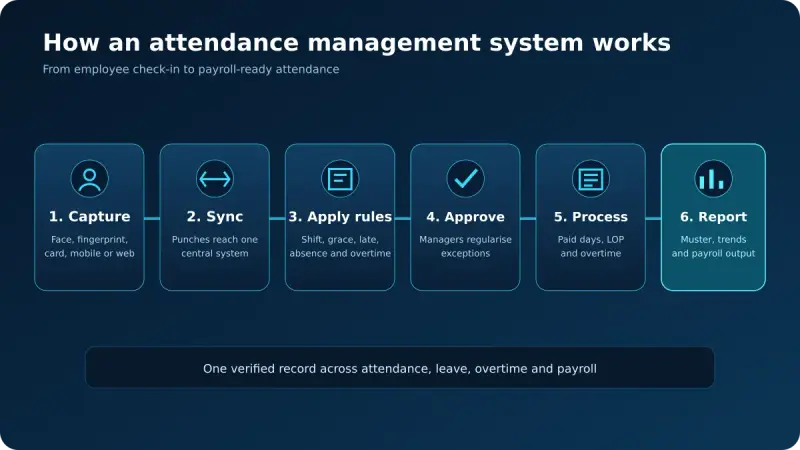Attendance data moves through six stages: capture, sync, rules, approval, processing and reporting.
An attendance management system works in six steps: capture, sync, apply rules, approve, process and report.
1. Capture: The employee checks in with a fingerprint, face scan, RFID card, mobile app or web login. Each punch is time-stamped and, for mobile, location-tagged.
2. Sync: Devices and apps send punches to the attendance software on a server or in the cloud, usually in real time.
3. Apply rules: The system compares each punch with the employee's shift and policy: grace period, late mark, early exit, half day, absent, weekly off, holiday and overtime.
4. Approve and regularise: Missed punches, on-duty days and work-from-home requests go to managers for approval, with a clear audit trail.
5. Process: Approved attendance is linked with leave balances and sent to payroll as paid days, loss of pay (LOP) and overtime hours.
6. Report: HR and managers see daily muster, late-coming trends, overtime and absenteeism by team or site.
Example: An employee's shift starts at 9:30 with a 10-minute grace period. A 9:38 punch is on time, a 9:45 punch is marked late, and three late marks in a month can be set to deduct half a day automatically, if that is your written policy. Leave requests flow in from your [leave management software](https://translineindia.com/blog/leave-management-software-features-india), so the attendance and leave records never conflict.
## Types of attendance systems
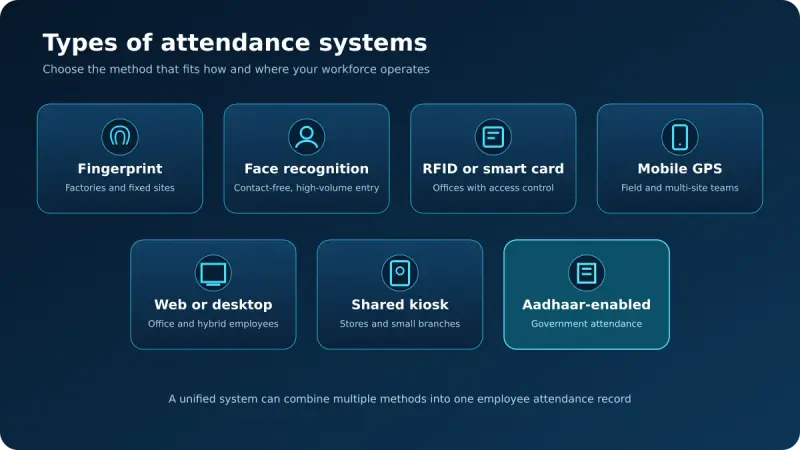Different attendance methods suit factories, offices, field teams, retail sites and government departments.
The main types of attendance system are biometric (fingerprint and face), card-based (RFID), mobile (GPS, geofence and selfie), web-based and Aadhaar-enabled systems. Each suits a different kind of workforce.
Method
How it works
Best for
Watch-outs
Fingerprint biometric
Employee places a finger on a reader that matches a stored template
Factories, offices, single-entry sites
Worn or dirty fingers, hygiene concerns, queues at shift change
Face recognition
A device or app matches the employee's face, often with liveness checks
High-volume entries, contact-free sites, hospitals
Lighting and camera angle affect accuracy; face data needs strong privacy controls
RFID or smart card
Employee taps a card on a reader
Sites already using card access control
Cards can be shared, so buddy punching is possible without a second factor
Mobile GPS and geofence
App marks attendance only inside an approved location, often with a selfie
Field sales, service engineers, multi-site staff
Fake-location apps, battery and permission issues
Online (web or desktop)
Employee logs in from a browser or system, often restricted by IP
Office and remote knowledge workers
Weak proof of presence on its own
Kiosk or shared device
A tablet at the entrance runs face or PIN check-in
Retail stores, small branches
Needs secure mounting and stable connectivity
Aadhaar-enabled (AEBAS)
Biometric or face is verified against Aadhaar
Central and state government offices
Mainly for government use; device and network readiness
For deeper guides, see our posts on [biometric attendance machine price](https://translineindia.com/blog/biometric-attendance-machine-price-india), [face recognition](https://translineindia.com/blog/hrms-attendance-management/facial-recognition) and [GPS attendance](https://translineindia.com/blog/hrms-attendance-management/gps-geo-location-employee-attendance-management-systems).
### Which attendance system fits your workforce
- Factory or plant: Fingerprint or face devices at gates, with shift and overtime rules.
- Corporate office: Face or card at entry, plus web check-in for hybrid days.
- Field teams: Mobile app with geofencing and selfie check-in.
- Retail chain: A face or fingerprint device or kiosk in each store, with a central dashboard.
- Government office: AEBAS or Aadhaar face authentication, as Sikkim and the MP Secretariat are doing.
- Mixed workforce: One online attendance management system that accepts all of the above, so HR sees one record.
Choosing and placing devices well matters as much as the software. Our [biometric attendance solutions](https://translineindia.com/solutions/biometrics) team can help plan this.
## Must-have features of attendance management software
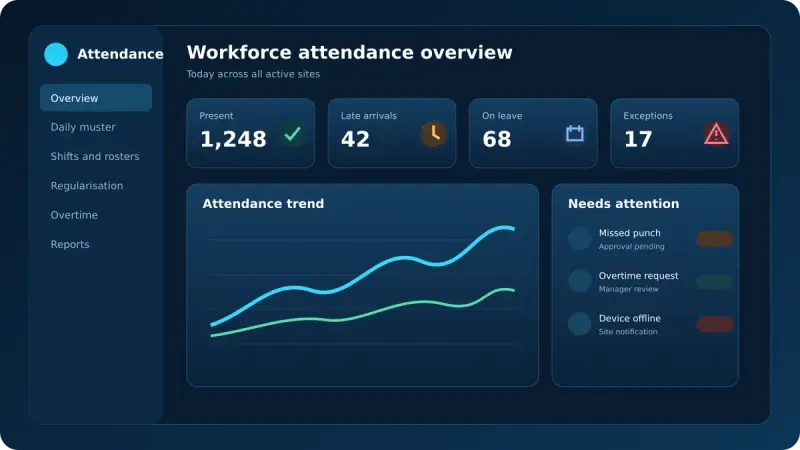A central dashboard helps HR monitor attendance trends, exceptions, overtime and device status.
Good attendance management software automates your rules, not just the punches. Look for these features:
- Multiple capture modes (biometric, face, card, mobile, web) feeding one record.
- Shift and roster management for general, rotational and night shifts.
- Policy engine for grace periods, late marks, early exits, half days and LOP.
- Overtime and comp-off calculation with approval.
- Regularisation workflow for missed punches, on-duty and work from home.
- Leave integration, so it works as a leave and attendance management system.
- Payroll export or integration with paid days, LOP and overtime.
- Employee and manager self-service on mobile.
- Multi-site dashboards and daily muster reports.
- Audit trail and role-based access, so every change is logged.
- Device management to see which readers are online.
## Attendance, the labour codes and payroll
Since 21 November 2025, India's four labour codes govern working hours, overtime and records, so your attendance rules must match them. The Code on Wages, 2019, the Industrial Relations Code, 2020, the Code on Social Security, 2020 and the Occupational Safety, Health and Working Conditions (OSH) Code, 2020 took effect from that date, rationalising 29 existing labour laws ( [PIB, 2025](https://www.pib.gov.in/PressReleseDetailm.aspx)).
The points that touch attendance most directly, as summarised by the government ( [PIB, 2025](https://www.pib.gov.in/PressReleasePage.aspx)):
Labour code rule
What to set in your attendance system
Normal working hours capped at 8 hours a day and 48 hours a week (OSH Code)
Shift lengths and weekly hour alerts
Overtime only with worker consent and paid at twice the regular rate (OSH Code, Code on Wages)
Overtime approval workflow and accurate overtime hours to payroll
Women can work night hours (before 6 AM, beyond 7 PM) with consent (OSH Code)
Night shift flags and consent records
Electronic maintenance of records, registers and returns (Code on Social Security; Industrial Relations Code)
Digital attendance and overtime records with an audit trail
Timely payment of wages and no unauthorised deductions (Code on Wages)
Clear LOP rules, approvals and payroll cut-off dates
State rules and sector notifications add detail, so map each rule to a setting with your HR and legal advisers. Government departments have their own attendance and service rules; our guide on [HR software for government departments](https://translineindia.com/blog/government-technology-solutions/how-government-organisations-automate-hr-operations-hrms-software) covers that side. This section is general information, not legal advice.
## Biometric data, privacy and the DPDP Act
Fingerprints, face templates and location data are personal data, so attendance systems fall under India's Digital Personal Data Protection Act, 2023. The DPDP Rules, 2025 were notified in November 2025 with an 18-month phased compliance timeline, and they require standalone, clear notices that explain the specific purpose of data collection ( [PIB, 2025](https://www.pib.gov.in/PressReleseDetailm.aspx)).
- **Notice and purpose:** Tell employees what attendance data you collect, why and for how long.
- **Minimise:** Track location only between check-in and check-out, not all day.
- **Secure templates:** Store biometric templates encrypted, not raw images, where possible.
- **Limit access:** Only HR and approved managers should see attendance and location data, with logged access.
- **Retention:** Delete data on a fixed schedule once legal record-keeping needs are met.
- **Alternatives:** Offer another method for staff whose fingerprints do not read well.
- **Vendor terms:** Put data protection clauses in contracts with software and device vendors.
Face-based identity checks are spreading fast. In October 2026, the government said it plans facial recognition screening for airport and airline staff, linked to digital entry passes ( [ID Tech, 2026](https://idtechwire.com/india-plans-mandatory-facial-recognition-for-airport-and-airline-staff/)). Employees will ask how their data is protected, so have clear answers ready.
## Attendance management by industry in India
The right setup depends on how and where your people work.
Industry
Common method
Key challenge
[Government](https://translineindia.com/industries/government)
AEBAS, Aadhaar face authentication
Large headcount, many offices, public accountability
[Manufacturing and industrial](https://translineindia.com/industries/industrial-infrastructure)
Fingerprint or face at gates, contract worker tracking
Shifts, overtime, contractor attendance
[Retail](https://translineindia.com/industries/retail)
Store device or kiosk, mobile for area managers
Many small sites, rotational shifts
[Healthcare](https://translineindia.com/industries/healthcare)
Contact-free face recognition
24x7 rosters, hygiene, night shifts
[Education](https://translineindia.com/industries/education)
Face or fingerprint for staff, app for students
Staff and student attendance in one place
[Corporate offices](https://translineindia.com/industries/corporate-real-estate)
Face or card at entry, web check-in for hybrid days
Hybrid policies, multiple office locations
Schools and colleges have specific needs; read our guide to [attendance software for schools](https://translineindia.com/blog/hrms-attendance-management/smart-attendance-software-for-schools).
## Attendance management system cost in India: what drives the price
Attendance management system cost depends on users, capture devices, sites, integrations and support, not one fixed price. Two companies with the same headcount can have very different budgets.
Cost driver
Why it matters
How to control it
Software licence
Usually priced per employee per month or as a one-time licence
Compare total cost over 3 years, not the first-year price
Capture devices
Fingerprint, face and card readers vary widely in price and capacity
Size devices to peak shift-change traffic; use mobile for field staff
Number of sites
Each site needs devices, power and connectivity
Use cloud sync and standard device models across sites
Integrations
Payroll, ERP, access control or AEBAS links take setup time
Choose software with standard exports and APIs
Implementation
Policy setup, employee enrolment and data migration
Write policies first and clean employee data before go-live
Support and AMC
Devices need servicing and software needs updates
Agree response times and on-site support in your cities
Basic web attendance is available free or cheaply from many vendors, but biometric devices, multi-site support and payroll integration add cost. For hardware ranges, see our [biometric attendance machine price guide](https://translineindia.com/blog/biometric-attendance-machine-price-india). For a full quote, [get a site-specific estimate](https://translineindia.com/contact).
## How to choose and roll out an attendance management system
Write your attendance policy first, then pick the tool that enforces it. Follow these steps:
1. **Write the policy:** shifts, grace period, late marks, half day, overtime, regularisation and approvals.
2. **Map your workforce:** office, shop floor, field, hybrid and contract staff, by site.
3. **Pick capture methods:** one per group, all feeding one system.
4. **Check integrations:** payroll, leave, ERP, access control and, for government, AEBAS.
5. **Plan privacy:** notice, consent where needed, access roles and retention.
6. **Run a pilot:** 2-4 weeks at one or two sites; compare system totals with your current records.
7. **Migrate:** move employee masters, shifts and leave balances from registers or Excel, then run both in parallel for one payroll cycle.
8. **Train and review:** train managers on approvals and review exception reports monthly.
Excel can work for a very small team, but once you have shifts, overtime or more than one site, manual sheets cause payroll errors and give you no audit trail.
## How Transline helps
Transline Technologies combines HRMS software, biometric devices and on-site support for organisations across India.
- [IDOne](https://translineindia.com/products/idone): our HRMS for attendance, leave and core HR workflows in one place.
- [Biometrics](https://translineindia.com/solutions/biometrics): selection, installation and integration of biometric and face attendance devices.
- [IT infrastructure](https://translineindia.com/solutions/it-infrastructure): network and connectivity so devices across sites stay in sync.
Ready to move off registers and spreadsheets? [Talk to our team](https://translineindia.com/contact) for a demo and a rollout plan for your sites.
## FAQs
Q: What is an attendance management system?
A: An attendance management system is software, often with biometric or mobile check-in, that records employee work time, applies shift, leave and overtime rules, and sends accurate attendance data to payroll. It replaces paper registers and spreadsheets with automatic, auditable records.
Q: What are the types of attendance systems?
A: The main types are fingerprint biometric, face recognition, RFID or smart card, mobile GPS and geofence, online web or desktop check-in, kiosk-based and Aadhaar-enabled (AEBAS) systems. Many organisations combine two or more methods in one system.
Q: How does a biometric attendance system work?
A: Each employee's fingerprint or face is enrolled as an encrypted template. At check-in, the device matches the live scan against the template, time-stamps the punch and sends it to the attendance software, which applies your shift rules.
Q: Can I manage attendance in Excel?
A: For a very small team, yes. Once you have shifts, overtime, several sites or contract staff, Excel leads to errors and offers no proof of presence or audit trail, so attendance software becomes the safer choice.
Q: What is the difference between an attendance system and HRMS?
A: An attendance system handles time and attendance. An HRMS includes attendance plus leave, payroll, employee records and other HR processes, so all modules share the same employee data.
Q: How do you stop buddy punching?
A: Use biometric or face recognition with liveness checks, selfie check-in with geofencing for mobile staff, and audit trails that show every edit. Regular manager review of exceptions also helps.
Q: Is biometric attendance legal in India?
A: Yes. Biometric attendance is widely used, including AEBAS in government offices. Biometric data is personal data under the DPDP Act, 2023, so give clear notice, limit use to attendance, control access and set retention periods. Take legal advice for your situation.
Q: How much does an attendance management system cost in India?
A: It depends on the number of employees, the type and number of devices, sites, integrations and support. A short requirements call and site survey give the most accurate estimate.
---
This blog is powered by Superblog. Visit https://superblog.ai to know more.
---